The Cartographer’s Dilemma: Navigating Without a Compass
In the grand atlas of human cognition, there is no territory more expansive, nor more daunting, than the vast expanse of the unknown. As Master Cartographers of our own intellect, we are often taught that learning is the process of filling in the blanks—of drawing firm lines where once there was only mist. We seek certainty. We crave the solid ground of a proven theorem or the unshakeable foundation of a historical fact. Yet, recent breakthroughs in learning science suggest that the most profound cognitive growth occurs not when we arrive at a destination, but when we are lost in the fog of uncertainty.The brain, it turns out, is not a static map but a dynamic engine of prediction. It is constantly surveying the horizon, weighing probabilities, and adjusting its internal coordinates. This process, known as flexible uncertainty handling, is the subject of our current expedition. By understanding how the neural pathways of the brain navigate ambiguity, we can better design educational landscapes that foster resilience, creativity, and deep understanding.
We often think of the brain as a library of information, but a more accurate metaphor is that of a coastal surveyor. Every sensory input, every new fact, and every unexpected result is a new measurement that must be reconciled with our existing mental maps. When the new data fits our expectations, the brain remains in a state of 'exploit'—using what it knows to navigate efficiently. But when the data is ambiguous, the brain shifts into 'explore' mode. This transition is not merely psychological; it is physiological, involving complex cascades of neurotransmitters and shifts in neural connectivity.
The Neural Topography of Ambiguity
To map the brain’s relationship with uncertainty, we must first look at the specialized regions that act as our cognitive scouts. Research has identified the anterior cingulate cortex (ACC) and the orbitofrontal cortex (OFC) as primary hubs for processing ambiguous information. These areas do not simply signal 'error' when a prediction fails; they calculate the degree of uncertainty and decide how much 'weight' to give new data.Imagine standing at a crossroads in a strange land. If your map says to go left, but the path looks overgrown and dangerous, your brain must decide whether the map is outdated or if your eyes are deceiving you. This is the essence of uncertainty handling. In a learning environment, when a student encounters a problem that doesn't fit their existing mental models, these neural scouts go to work. They analyze the signal-to-noise ratio of the new information. If the uncertainty is high, the brain enters a state of heightened plasticity, preparing to redraw its internal maps.
This plasticity is a finite resource, however. The brain cannot remain in a state of high-alert exploration indefinitely. This is why the 'optimal challenge'—the zone where uncertainty is present but not overwhelming—is so crucial for learning. If a task is too certain, the brain disengages, repeating known patterns without building new ones. If it is too uncertain, the system becomes overloaded, leading to frustration and withdrawal. The Master Cartographer seeks the 'sweet spot' of ambiguity, where the fog is thin enough to see through but thick enough to require a compass.
The Pedagogy of the Unknown
How do we translate these neurological findings into the classroom or the study hall? The traditional model of education often prioritizes 'correctness' above all else. We reward the student who knows the answer immediately and penalize the one who hesitates. However, this approach inadvertently trains the brain to avoid uncertainty, treating it as a threat rather than an opportunity for exploration.A more effective pedagogical strategy—one aligned with the brain’s natural architecture—is the 'Scaffolded Struggle.' This involves presenting students with problems that are just beyond their current level of certainty. It requires them to inhabit the space of the unknown for a period before the solution is revealed. This 'productive failure' forces the ACC and OFC to engage deeply, strengthening the neural circuits responsible for flexible thinking.
In this model, the teacher does not provide the destination; they provide the tools for the journey. They teach the student how to formulate hypotheses, how to test them, and how to interpret the results when they are ambiguous. This shift from 'answer-centric' to 'process-centric' learning is essential for building the cognitive resilience needed in the 21st century. It transforms the student from a traveler following a pre-drawn path into a cartographer charting their own course.
Building Cognitive Resilience Through Probabilistic Learning
In the modern era, where information is abundant but often contradictory, the ability to think probabilistically is more critical than ever. This is the skill of assigning degrees of confidence to our beliefs rather than viewing the world in binary terms. The Master Cartographer knows that every map is a simplification, and every boundary is a hypothesis.Probabilistic learning encourages students to ask, 'How sure am I of this?' rather than just 'Is this right?' This subtle shift in questioning transforms the learning process. It moves us away from rote memorization and toward a nuanced understanding of systems. When we learn to handle uncertainty flexibly, we become less susceptible to misinformation and more open to changing our minds in the face of new evidence.
Think of it as the difference between a static image and a heat map. A static image gives you a single, definitive answer. A heat map shows you the areas of high confidence and the areas of high uncertainty. By training our brains to see the world as a heat map, we become better at navigating complexity. We learn to identify the 'hot spots' of reliable information and the 'cold spots' where more exploration is needed. This is the foundation of scientific literacy and critical thinking.
Technology as a Compass for Uncertainty
EdTech innovations are beginning to leverage these insights. Adaptive learning platforms, when designed correctly, don't just provide the right answers; they provide the right amount of uncertainty. By tracking a student's confidence levels and response times, these tools can dynamically adjust the difficulty of a task to keep the learner in the 'Optimal Uncertainty Zone.'Furthermore, generative AI tools offer a unique sandbox for exploring ambiguity. Because these systems are themselves probabilistic, they can be used to generate multiple perspectives on a single issue, forcing the learner to evaluate and synthesize diverse viewpoints. The goal of technology in education should not be to remove the fog of uncertainty, but to provide the tools necessary to navigate through it.
Consider a history student using AI to explore different interpretations of a historical event. The AI doesn't just give a single 'correct' narrative; it can present the event through the eyes of different participants, highlight the gaps in the historical record, and suggest areas where historians disagree. This forces the student to engage with the uncertainty of the past and to build their own coherent map based on the available evidence. This is the true power of AI in education—not as a substitute for thought, but as a catalyst for it.
The Emotional Landscape of Learning
We cannot discuss the brain’s navigation of the unknown without addressing the emotional terrain. Uncertainty often triggers the amygdala, the brain’s center for fear and stress. If the level of ambiguity is too high, or if the environment is punitive, the learner experiences 'cognitive shutdown.' The scouts are called back, and the brain retreats to familiar territory.Creating a 'psychologically safe' learning environment is therefore a prerequisite for flexible uncertainty handling. Students must feel that it is safe to be wrong—that their worth is not tied to their immediate accuracy but to their willingness to explore. When the emotional climate is supportive, the brain can redirect its energy from self-protection to map-making.
This emotional safety is built through trust and curiosity. When a teacher models curiosity in the face of the unknown—when they say 'I don't know, let's find out together'—they give their students permission to be uncertain. They show that the search for knowledge is an adventure, not a test. This reduces the 'threat' level of ambiguity and allows the brain’s executive functions to remain in control, even when the path ahead is unclear.
The Evolutionary Roots of Predictive Processing
To truly appreciate the brain’s prowess in handling uncertainty, we must look back at our evolutionary history. For our ancestors, the ability to predict the movement of a predator or the location of a food source was a matter of survival. The brain evolved as a survival mechanism that minimizes surprise. In the parlance of modern neuroscience, this is known as the 'Free Energy Principle.' The brain is constantly trying to reduce the difference between its internal model of the world and the sensory input it receives.However, a brain that is too rigid in its predictions becomes a liability. If the environment changes—say, a familiar watering hole dries up—the brain must be able to recognize that its old map is no longer valid and adapt. This balance between 'exploitation' (using known information) and 'exploration' (seeking new information) is the fundamental tension of cognitive life. In the classroom, we see this play out when a student relies on a memorized formula even when a more creative solution is required. By understanding these evolutionary pressures, we can better appreciate why the brain finds uncertainty both challenging and necessary.
The modern world, however, presents a set of challenges that our ancestors never faced. The pace of change is faster, the amount of information is greater, and the 'noise' is louder. Our evolutionary drive to minimize surprise can lead us to seek out information that confirms what we already know—the 'echo chamber' effect. To counter this, we must consciously cultivate a 'pro-uncertainty' mindset, leaning into the discomfort of new ideas to keep our cognitive maps fresh.
The Impact of Chronic Certainty on Cognitive Flexibility
What happens when we are shielded from uncertainty for too long? In an age of algorithms that feed us exactly what we want to see, our 'uncertainty muscles' can atrophy. Chronic certainty leads to cognitive rigidity—a state where we are unable to process information that contradicts our existing beliefs. This is the antithesis of the Master Cartographer’s mindset.Cognitive rigidity manifests in education as a refusal to engage with complex, multi-faceted problems. It leads to a 'black-and-white' view of history, a 'follow-the-manual' approach to science, and a 'fill-in-the-bubble' mentality toward assessment. To combat this, we must intentionally introduce 'constructive ambiguity' into our lives. We must challenge ourselves to read books we disagree with, to learn languages that use different logical structures, and to engage in hobbies where we are rank beginners.
This process of 'de-certainty' is painful but necessary. It’s like clearing an overgrown path on an old map. It requires effort and focus, but it reveals new territories that were previously hidden. By embracing the 'beginner’s mind,' we keep our neural scouts active and our internal maps dynamic. This is the secret to lifelong learning and the hallmark of a truly educated mind.
The Role of Metacognition in Navigating Ambiguity
Metacognition—thinking about our own thinking—is the ultimate tool in the Cartographer’s kit. When we are aware of our own cognitive biases and the shortcuts our brains take to avoid uncertainty, we can intervene in the process. We can ask ourselves, 'Am I rejecting this idea because it's wrong, or because it makes me feel uncertain?'In educational settings, teaching metacognitive strategies is as important as teaching the subject matter itself. Students should be encouraged to reflect on their learning journey: where they felt lost, how they found their way back, and what clues they used to navigate the fog. This self-awareness transforms the experience of uncertainty from a confusing muddle into a structured investigation.
For example, a student struggling with a complex math problem might be taught to pause and identify the specific point where their certainty vanished. Was it a particular term? A missing step? By pinpointing the 'fog line,' they can focus their efforts on clearing that specific area rather than feeling overwhelmed by the entire problem. This is metacognition in action—the act of observing the observer.
Designing Future-Proof Learning Ecosystems
As we look toward the horizon of 2030 and beyond, the educational landscapes we build must be fundamentally different from the factories of the past. We need learning ecosystems that are 'uncertainty-native.' This means moving away from standardized testing as the primary metric of success and toward 'competency-based' models that value the ability to apply knowledge in novel, ambiguous situations.Project-based learning, interdisciplinary studies, and real-world internships are the hallmarks of such a system. They provide the 'wild' terrain where students can practice their navigation skills. In these environments, the teacher’s role shifts from the 'font of all knowledge' to the 'expert guide.' They don't give the students the map; they teach them how to use the compass and the astrolabe.
A future-proof ecosystem also recognizes that learning happens everywhere, not just in a classroom. It encourages students to explore the boundaries between disciplines—to see the physics in music, the biology in architecture, and the philosophy in coding. This 'boundary-crossing' is where the most significant innovations occur, and it requires a high degree of comfort with uncertainty.
The Ethics of Uncertainty in an Automated World
Finally, we must consider the ethical dimensions of uncertainty. As AI takes over more of the 'certain' tasks—the calculations, the data retrieval, the rote procedures—humanity’s unique value will lie in our ability to handle the 'uncertain' tasks. The ethical dilemmas, the complex social negotiations, and the creative leaps that AI cannot yet replicate.If we fail to teach our children how to navigate ambiguity, we are essentially ceding our agency to the machines. We are training them for a world that no longer exists. However, if we empower them to embrace uncertainty, we are giving them the keys to the future. We are ensuring that they remain the Master Cartographers of the human experience, capable of charting a course through even the most turbulent seas.
Ethics itself is a field defined by uncertainty. There are rarely 'correct' answers, only better or worse arguments based on competing values. By teaching students to navigate the ethical fog, we prepare them to lead with integrity in a world where the right path is often obscured. This is the highest form of mapping—drawing a line between 'what is' and 'what ought to be.'
Deep Dive: The Bayesian Brain Hypothesis
To understand the mechanics of uncertainty, we must delve into the 'Bayesian Brain' hypothesis. This theory suggests that the brain functions as a statistical inference engine, constantly updating its beliefs based on new evidence—a process named after Thomas Bayes. In this model, every perception is a 'posterior' probability, formed by combining a 'prior' belief with current 'likelihood' data.For example, when you see a blurry shape in the distance, your brain uses its 'priors' (what you expect to see in that environment) to make an initial guess. As you get closer and the data becomes clearer, the 'likelihood' increases, and your brain updates its belief. This is a perfect metaphor for the learning process. We never start with a blank map; we start with a set of priors. Learning is the continuous refinement of these priors through the acquisition of new, often uncertain, information.
Educators who understand this can help students identify their own 'priors'—their biases and assumptions—before they begin the process of updating them with new knowledge. They can show students how to weigh 'evidence' appropriately, avoiding the trap of over-correcting for a single outlier or ignoring a mountain of data that contradicts a cherished belief. This is the art of rational navigation.
The Paradox of Choice and the Fog of Information
In our modern information landscape, we often face a different kind of uncertainty: the uncertainty born of too much choice. This is the 'Paradox of Choice,' where an abundance of options leads to paralysis rather than freedom. For the student, this manifests as a struggle to find a starting point in a sea of available resources. How do you choose the 'best' source? How do you know which path to follow in your research?The Master Cartographer handles this by using 'heuristics'—mental shortcuts that help navigate complexity without becoming overwhelmed. They learn to filter the noise and focus on the high-signal markers. They understand that 'perfect' is the enemy of 'progress' and that an imperfect map used with skill is better than no map at all.
In the digital age, this means learning how to assess the credibility of sources, how to use advanced search techniques, and how to synthesize information from multiple formats. It’s about becoming a curator of information, not just a consumer. By mastering these filtering skills, the learner can cut through the fog of information and find the solid ground they need to build their knowledge.
The Intersection of Art and Science in Map-Making
Mapping the unknown is not just a scientific endeavor; it is an artistic one. It requires intuition, imagination, and the ability to see patterns where others see only chaos. The great scientific breakthroughs—from Einstein’s relativity to Curie’s radioactivity—were born of a creative leap into the dark. These pioneers did not have a map; they had to imagine one.By integrating the arts into the science of learning, we encourage this kind of creative uncertainty handling. We teach students to embrace the 'aesthetic' of the unknown—the beauty of a problem that hasn't been solved yet. We show them that the most elegant maps are those that leave room for wonder.
Whether it’s through music, visual arts, or literature, the 'arts' provide a safe space to practice being lost. They allow us to explore different perspectives, to experiment with new forms, and to find meaning in ambiguity. This holistic approach ensures that the next generation of cartographers is not just technically proficient, but inspired.
Practical Takeaways for the Knowledge Explorer
1. Embrace the Pause: When you encounter something you don't understand, don't rush to find the answer immediately. Sit with the uncertainty and observe how your brain tries to make sense of it. This pause allows your ACC and OFC to engage more fully.2. Think in Probabilities: Instead of asking if something is 'true' or 'false,' ask what the probability is that it is true given the evidence you have. This trains your brain to handle nuance and avoid binary thinking.
3. Seek Out Divergent Views: Actively engage with information that challenges your existing maps. This forces your brain to recalibrate and strengthen its uncertainty-handling circuits. It’s the cognitive equivalent of a hard workout.
4. Foster a Growth Mindset: Remind yourself that being 'lost' is a necessary part of the learning process. The discomfort of not knowing is the sound of your neural maps being redrawn. Celebrate the struggle as a sign of growth.
5. Use Tools to Explore, Not Just Resolve: Use AI and search engines not just to find the 'correct' answer, but to understand the breadth of a topic and the various ways it can be interpreted. Let technology be your astrolabe, not just your GPS.
6. Reflect on Your Navigation: At the end of a study session or a project, take a moment to look back at the fog you traversed. What strategies worked? Where did you get stuck? This metacognitive reflection is how you become a Master Cartographer.
Conclusion: The Map is Never Finished
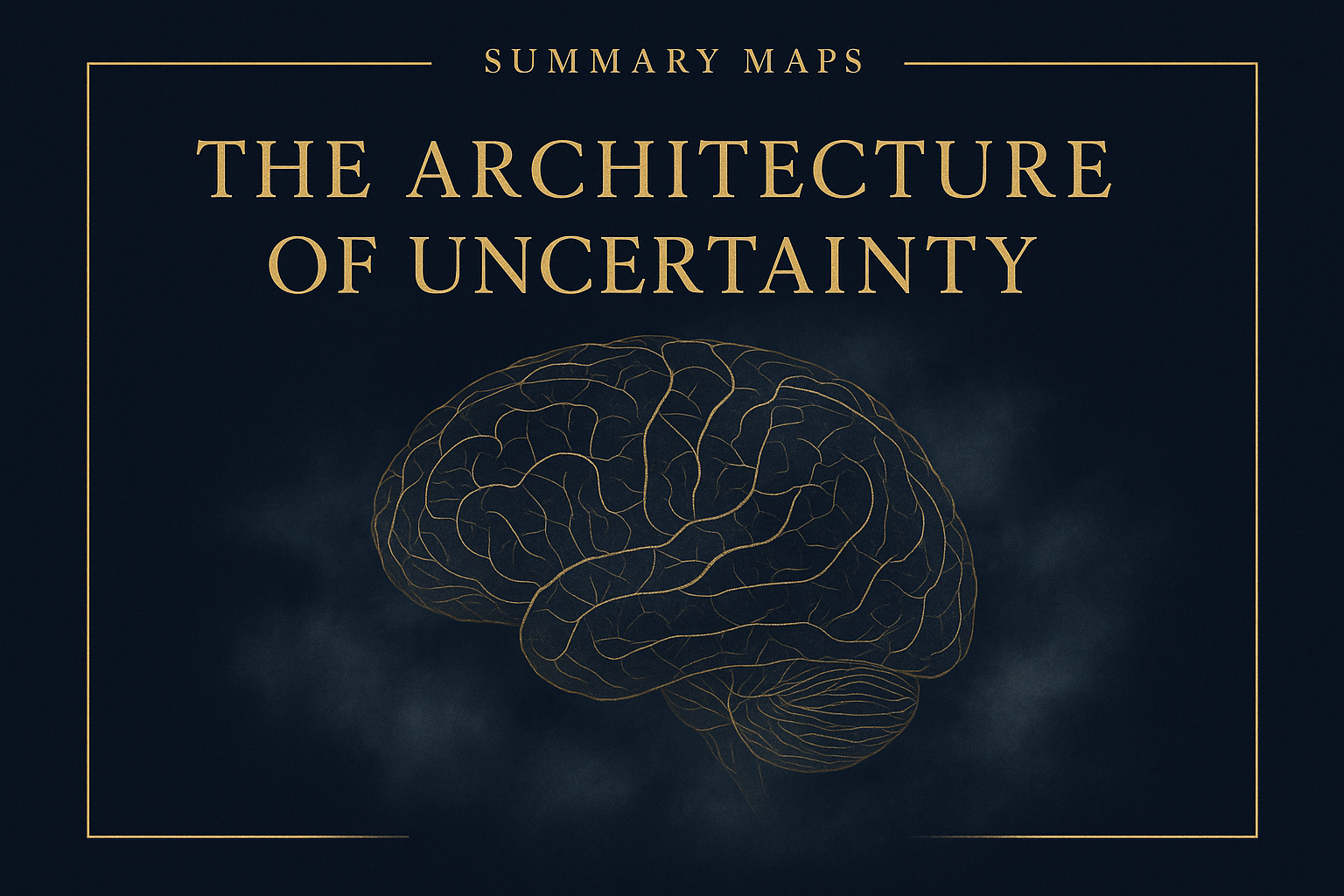
As we conclude this expedition into the architecture of uncertainty, we must remember that the map of knowledge is never truly finished. The boundaries of science, art, and history are constantly shifting as new territories are discovered. The most successful learners of the future will not be those who have memorized the most static facts, but those who are the most skilled at navigating the unknown.By embracing the fog, by leaning into the struggle, and by refining our internal compasses, we can transform the challenge of uncertainty into a lifelong journey of discovery. The Master Cartographer does not fear the blank spaces on the map; they see them for what they truly are: the frontiers of a greater understanding. Step boldly into the unknown, Knowledge Explorer. The stars are waiting to be charted.
Want to go deeper?
Turn this book into an interactive visual mind map on Summary Maps. Explore every chapter, key idea, and connection — all in one view.
Try Summary Maps Free →