Why Questions Matter More Than Answers
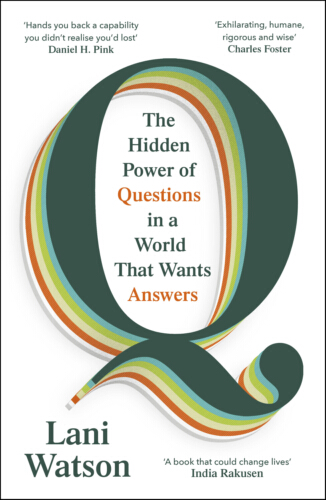
We live in a world obsessed with answers. Search engines deliver instant results. AI chatbots respond in seconds. Productivity culture rewards certainty and decisiveness. But what if the most powerful tool for understanding ourselves, building better relationships, and navigating complexity has been hiding in plain sight all along?In Q: The Hidden Power of Questions in a World That Wants Answers, Oxford philosopher Lani Watson makes a compelling case that questions are not merely a pathway to answers—they are powerful cognitive and social instruments in their own right. This is a book that challenges everything we think we know about knowledge, curiosity, and how we engage with the world around us.
Watson draws from philosophy, psychology, neuroscience, and history to build an argument that is both intellectually rigorous and deeply practical. From Socrates to artificial intelligence, from courtrooms to classrooms, from therapy sessions to boardrooms, she demonstrates that the quality of our questions determines the quality of our lives.
The Problem With an Answer-First World
Watson identifies a fundamental imbalance in modern culture: we have become answer-oriented to a fault. We prize people who have answers—experts, gurus, decisive leaders—while often dismissing those who ask probing questions as uncertain or indecisive.This answer-first mentality creates real problems. It leads us to value certainty over exploration, to rush past the inquiry phase where genuine understanding is formed. In education, students learn to produce correct answers rather than generate meaningful questions. In workplaces, employees are rewarded for solutions but rarely for the curiosity that precedes innovation.
Watson argues this imbalance costs us dearly. When we skip the questioning phase, we often solve the wrong problems, miss crucial nuances, and build relationships on assumptions rather than genuine understanding. The answer-oriented world, she contends, is paradoxically less knowledgeable because it undervalues the very process through which knowledge is created.
Questions as Attentional Mechanisms
One of Watson's most striking insights is her framework of questions as attentional mechanisms. A question is not just a request for information—it is a tool that directs and sustains our focus. When you ask a question, you are choosing what to pay attention to. You are creating a lens through which you see the world.Consider the difference between asking "What went wrong?" and "What can we learn from this?" Both address the same situation, but they direct attention in radically different ways. The first focuses on failure and blame; the second opens space for growth and insight. Watson demonstrates that the questions we ask quite literally shape what we notice, what we remember, and what we understand.
This has profound implications for every domain of life. In healthcare, the questions a doctor asks determine which symptoms get explored and which get overlooked. In journalism, the questions posed to a source shape the story that emerges. In personal relationships, the questions we ask our partners and friends determine the depth of connection we achieve.
The Art of Questioning Well
Watson does not simply advocate for more questions—she makes the case for better questions. Drawing on her philosophical research into what she calls "epistemic virtues," she outlines qualities that distinguish powerful questions from empty ones.Good questions, Watson argues, share several characteristics. They are open enough to invite genuine exploration rather than confirmation of what we already believe. They are specific enough to direct attention productively. They demonstrate intellectual humility—an acknowledgment that our current understanding may be incomplete. And they create space for others to think, rather than cornering them into predetermined answers.
Watson introduces the concept of "questioning courage"—the willingness to ask questions that might reveal our ignorance, challenge authority, or disrupt comfortable assumptions. In a world where appearing knowledgeable is socially rewarded, asking genuine questions requires a particular form of bravery.
She also explores the relational dimension of questioning. The best questions are not just intellectually sharp—they signal genuine interest in another person's perspective. They build trust, create connection, and communicate respect. Watson shows how questioning well is an act of care as much as an act of intellect.
From Socrates to AI: Questions Across History
Watson takes readers on a fascinating journey through the history of questioning. She begins with Socrates, whose method of relentless inquiry remains the gold standard for philosophical questioning twenty-four centuries later. But she does not stop there.The book explores how questions have driven scientific revolutions, legal systems, therapeutic breakthroughs, and social movements. Watson examines how the right question at the right moment has repeatedly changed the course of history—from Darwin's inquiry about species variation to the courtroom questions that have established fundamental rights.
Particularly compelling is Watson's analysis of questions in the age of artificial intelligence. As AI systems become increasingly capable of generating answers, she argues that the human capacity for asking meaningful questions becomes more valuable, not less. AI can process and retrieve information at scale, but the ability to identify what questions are worth asking—what Watson calls "question generation"—remains a distinctly human skill that we must cultivate rather than abandon.
The Uneven Distribution of Questioning Power
Watson brings a critical lens to the politics of questioning. She demonstrates that the ability to ask questions is not evenly distributed in society. Some people—by virtue of their position, identity, or circumstances—have greater freedom to question than others.In many institutional contexts, questioning is a privilege. Students may be discouraged from questioning teachers. Employees may face consequences for questioning managers. Patients may feel unable to question doctors. Watson argues that democratizing the capacity to question is a matter of justice, not just intellectual enrichment.
She also examines how questions can be used as instruments of power—in interrogations, manipulative rhetoric, and systems of control. Understanding the ethics of questioning, Watson argues, is essential for navigating a world where questions can liberate or constrain depending on who wields them and how.
Q Tools: Building Your Questioning Practice
What sets this book apart from purely theoretical philosophy is Watson's inclusion of practical exercises she calls Q Tools. Each chapter concludes with actionable techniques readers can use to develop their questioning abilities in specific domains.These tools range from techniques for generating better questions in professional settings to practices for deepening personal relationships through inquiry. Watson provides frameworks for questioning your own assumptions, for asking questions that build trust in conversations, and for using questions to navigate uncertainty rather than rushing to premature closure.
The Q Tools transform the book from an intellectual argument into a genuine practice guide. Watson treats questioning as a skill—something that can be developed through deliberate practice rather than an innate talent some people have and others lack.
How Summary Maps Helps You Visualize Watson's Framework
Lani Watson's book is rich with interconnected ideas—from philosophical foundations to practical applications, from historical examples to contemporary challenges. This is exactly the kind of complex, multi-layered work that benefits from visual mapping.At Summary Maps, we believe that the best way to internalize a book's framework is to see its architecture. When you map Watson's argument visually, you can trace how her concept of questions-as-attention connects to her analysis of questioning courage, how the historical examples illuminate the theoretical framework, and how the Q Tools translate abstract principles into daily practice.
A visual mind map of Q reveals the book's elegant structure: the philosophical foundation of why questions matter, the practical taxonomy of how questions function, and the ethical dimension of who gets to question and how. Seeing these layers simultaneously helps you move beyond passive reading into active comprehension—which is, fittingly, the very inquiry mindset Watson advocates.
Key Takeaways to Apply Today
1. Pause before answering. When someone asks you a question, or when you encounter a problem, resist the impulse to answer immediately. Spend time with the question itself. Ask whether it is the right question, whether it could be reframed, whether a different question might be more productive.2. Practice question generation. Before your next meeting, conversation, or learning session, write down five questions you want to explore. Treat question-finding as a skill worthy of preparation, not something you improvise in the moment.
3. Notice your questioning patterns. Pay attention to the types of questions you habitually ask. Do you tend toward closed questions that confirm what you already believe? Or open questions that invite genuine discovery? Awareness is the first step toward expansion.
4. Create questioning-safe environments. Whether you lead a team, teach a class, or raise children, examine whether the people around you feel safe asking genuine questions. Reward curiosity and inquiry rather than just correct answers.
5. Use questions to deepen relationships. Replace surface-level small talk with genuine questions about other people's experiences, perspectives, and feelings. Watson shows that authentic questioning is one of the most powerful tools for building connection and trust.
6. Map the questions, not just the answers. When reading a complex book or navigating a difficult decision, create a visual map of the key questions rather than just the conclusions. This approach mirrors how understanding actually develops—through inquiry rather than assertion.
Final Reflection
Lani Watson's Q arrives at a moment when we desperately need it. In an age of information overload, algorithmic certainty, and AI-generated answers, the art of questioning well has never been more important or more endangered. Watson gives us both the philosophical foundation to understand why questions matter and the practical tools to become better questioners.This is not a book that simply tells you what to think—it teaches you how to inquire. And that, Watson would argue, is infinitely more valuable.
Ready to map this book? Get your copy of Q: The Hidden Power of Questions on Amazon and start building your visual mind map today.
Want to go deeper?
Turn this book into an interactive visual mind map on Summary Maps. Explore every chapter, key idea, and connection — all in one view.
Try Summary Maps Free →